
The Lie We Tell Ourselves #
If you ask a Junior Developer why they chose Microservices, they will say: “It’s scalable and decoupled.” If you ask a CTO why they chose Microservices, they might admit: “Because Netflix does it.”
In the last decade, “Monolith” became a dirty word. It became synonymous with “legacy code,” “spaghetti,” and “tech debt.” But here is the uncomfortable truth: Microservices usually create more tech debt than they solve—especially for teams under 50 engineers.
This blueprint isn’t about which one is “better.” It is about the logic of when to switch.
The “Distributed Monolith” Trap #
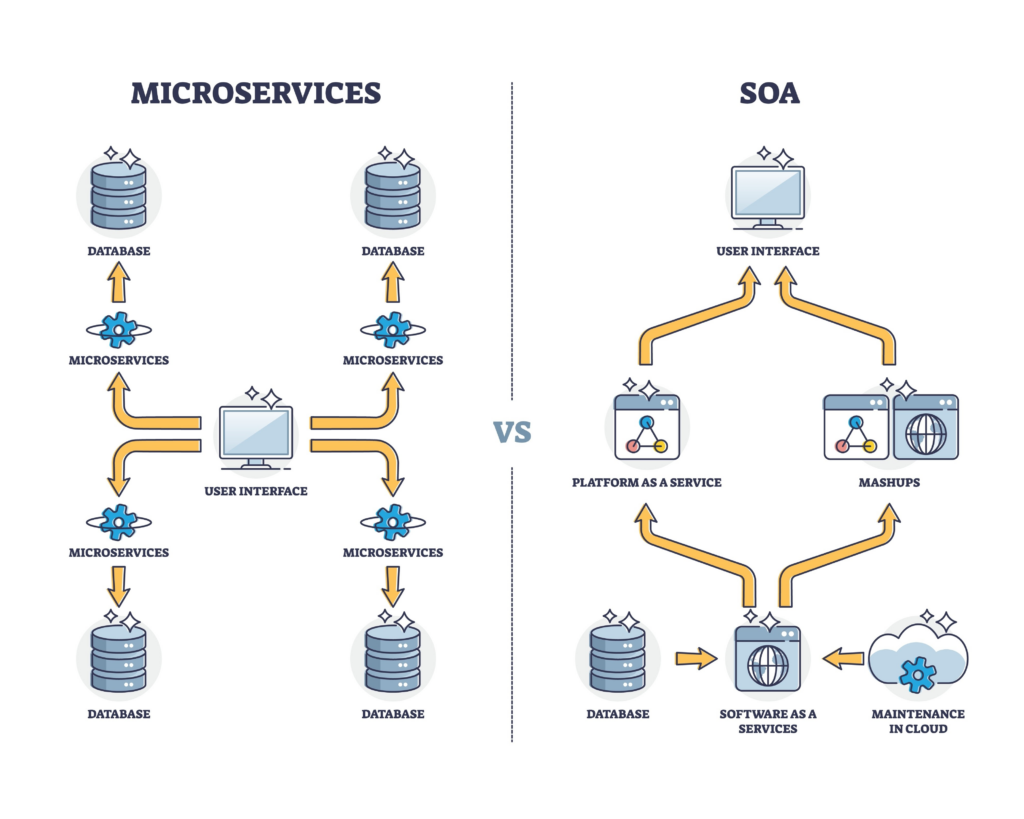
The most common failure pattern I see is the Distributed Monolith. This happens when you split your code into services, but they are still tightly coupled in logic.
- Scenario: You have a
User Serviceand anOrder Service. - The Problem: To create an order, the
Order Servicemakes a synchronous HTTP call to theUser Serviceto check the address. - The Crash: If the
User Servicegoes down, theOrder Servicefails. You have introduced network latency and unreliability, but gained zero independence. You now have the complexity of distributed systems with the fragility of a single application.
The Middle Ground: The Modular Monolith #
Before you jump to Microservices, you should be building a Modular Monolith. This is “The Logic Behind Your Tech Stack” in action.
In a Modular Monolith, code is separated into distinct domains (e.g., Inventory, Billing, Shipping) via strictly enforced public interfaces, but it is deployed as a single unit.
Why this wins:
- Zero Network Latency: Function calls are in-memory.
- ACID Transactions: You can use a single database transaction to update Inventory and Billing. No need for complex “Saga Patterns” or “Two-Phase Commits.”
- Refactoring is Cheap: Moving a function from
BillingtoShippingis a drag-and-drop operation. In Microservices, that’s a multi-repo migration project.
Architecture Diagram: The Evolution #
Here is how your architecture should logically evolve.
Stage 1: The Spaghetti Monolith (Avoid)
graph TD
    subgraph "The Spaghetti Monolith"
    A[UI] --> B[All Logic Mixed]
    B --> C[(Single DB)]
    end
Stage 2: The Modular Monolith (Target)
graph TD
subgraph "The Modular Monolith"
    D[UI] --> E[API Gateway]
    E --> F[Module: Auth]
    E --> G[Module: Billing]
    E --> H[Module: Inventory]
    F <--> G
    G <--> H
    F --> I[(Shared DB / Schema per Module)]
    G --> I
    H --> I
    end
Stage 3: Microservices (Scale Only)
graph TD
subgraph "Microservices (Scale Only)"
    J[UI] --> K[API Gateway]
    K --> L[Auth Service]
    K --> M[Billing Service]
    K --> N[Inventory Service]
    L --> O[(Auth DB)]
    M --> P[(Billing DB)]
    N --> Q[(Inventory DB)]
    end
The Logic Check: Decision Matrix #
Do not move to Microservices unless you check at least two of these boxes.
| Constraint | The Logic |
| Team Size | Are you > 50 Engineers? If you can’t feed a team with “two pizzas,” you might need to split the codebase so teams don’t block each other’s deployments. |
| Scale Variance | Does one part need 100x more resources? Example: Your Image Processing module crushes the CPU, slowing down the Checkout page. Moving just the Image Processor to a separate service makes sense. |
| Technology Diversity | Do you absolutely need a different language? Example: Your core app is Rails, but you need a high-performance matching engine in Rust. |
| Fault Isolation | Is one feature crashing the whole app? If the “Reporting” module runs out of memory and kills the “Login” page, separate them. |
Real-World Example: Segment.com #
A famous case study in “Un-architecting.” Segment started with a monolith. As they grew, they broke it into 140+ microservices. It worked for a while, but eventually, the overhead of maintaining 140 queues, load balancers, and CI pipelines destroyed their productivity.
The Fix: They merged those 140 services back into a single Centrifuge Monolith.
The Result: 30% reduction in infrastructure costs and significantly faster deployment times.
Conclusion: Logic > Hype #
Microservices are a solution to an organizational problem (too many devs), not a technical one. If you are a startup looking for speed, embrace the Modular Monolith. Focus on writing clean code boundaries, not managing Kubernetes YAML files.


